
Is UK Broadband Ready For Hybrid Working?

Hotspots and Notspots: Is UK broadband infrastructure ready for hybrid working?
How good is UK broadband? Depending on where you live, your options could range from high-speed fibre to a sluggish, intermittent connection. And in today’s working world, those stuck in the latter camp could face major obstacles.
Increasingly, employees are expected to be able to work on a remote or hybrid basis. When the working day is packed with video calls, thousand-row spreadsheets and hefty file downloads, an unreliable broadband connection is a severe disadvantage. Those not blessed with adequate broadband coverage could see their productivity dented.
That’s why we set out to determine the full extent of the UK’s broadband shortcomings. We’ve analysed the data and crunched the numbers, using Ofcom’s Connected Nations dataset to construct a top-down view of the state of UK broadband. From here, we built up a regional picture of connectivity across the UK, ranking the towns with the best and worst broadband coverage. Read on to learn what we found.
Left behind by the remote revolution
Broadband speed now matters more than ever before. And at the root of it all is the COVID-19 pandemic.
Before COVID struck, nine-to-five in the office and the daily commute were non-negotiable aspects of working life for most Brits. However, successive lockdowns laid the groundwork for ‘the new normal’ and it is now standard practice for workplaces to follow a hybrid approach, with employees coming into the office a few days a week and working from home the rest of the time. Some companies have done away with the office entirely, requiring their employees to work on a fully remote basis.
To work from home effectively, you need good broadband. Yet our analysis reveals that one in four workers fall short of the 30 megabits per second (Mbps) required to keep up with the ever-increasing bandwidth demands of modern work. And while there are a few broad geographical patterns to who does and doesn’t have solid connectivity – such as Scotland and Wales on average, being worse off than England – the biggest disparities tend to be town to town, postcode to postcode.
To work from home, you need good broadband. Yet one in four workers fall short of the 30 Mbps required to keep pace with modern workloads.
Though some towns have seen big lifts in connectivity following recent regeneration projects, such as Crawley in the Southeast of England, Nuneaton in the Midlands and Blackburn in the North West, others haven’t had the same luck. Fermanagh in Northern Ireland, Brecon in mid-Wales and Stockton in the Northeast of England are examples of towns in dire need of infrastructure upgrades.
This matters for businesses just as much as it does for individuals. Businesses want access to the best applicants, regardless of location. And individuals shouldn’t have their career options limited by a poor internet connection. Yet for many within the UK, this is the sad reality.
Different sectors, Different speeds
Our research also revealed differences in the bandwidth needs of different industries.
Unsurprisingly, IT & Telecoms comes top of the list, requiring 60 Mbps on average. In second place is the data-rich sector of Financial Services, with Customer Service rounding out the top three.
At the other end of the rankings, we have the Charity & Voluntary sector, which requires just 22.5 Mbps of its average worker. Then, Project Management and Business Development come second and third last respectively.
| Sector | Speed |
|---|---|
| IT & Telecoms | 60 Mbps |
| Financial Services | 48.5 Mbps |
| Customer Service | 47.5 Mbps |
| Medical & Health | 45.5 Mbps |
| Media, Digital & Creative | 33 Mbps |
| Sales | 27.5 Mbps |
| Education & Training | 26 Mbps |
| Business & Development | 25 Mbps |
| Project Management | 23.5 Mbps |
| Charity & Voluntary | 22.5 Mbps |
If you work remotely in an industry with heavy bandwidth requirements and plan to relocate, you may wish to consider the impact of broadband speeds on your productivity and property website Rightmove, can now provide this information. How many video calls will you have to field? Do you have to transfer large files? Will you be logging into a company VPN? The number of people sharing your connection has an impact too – two people working from your home could double the demands on your bandwidth.
Despite this variability between individuals and industries, sky-high speeds are rarely essential. What matters more is that employees have access to good enough broadband that will allow them to complete their tasks without any slowdown.
Yet a considerable chunk of the UK falls short of the bandwidth needed for even the lowest ranking sectors – 7% of the population receives under 10 Mbps. This presents a real barrier to successful remote working, especially when there is no physical office to work from if speed dips even lower.
7% of the UK population receives under 10 Mbps
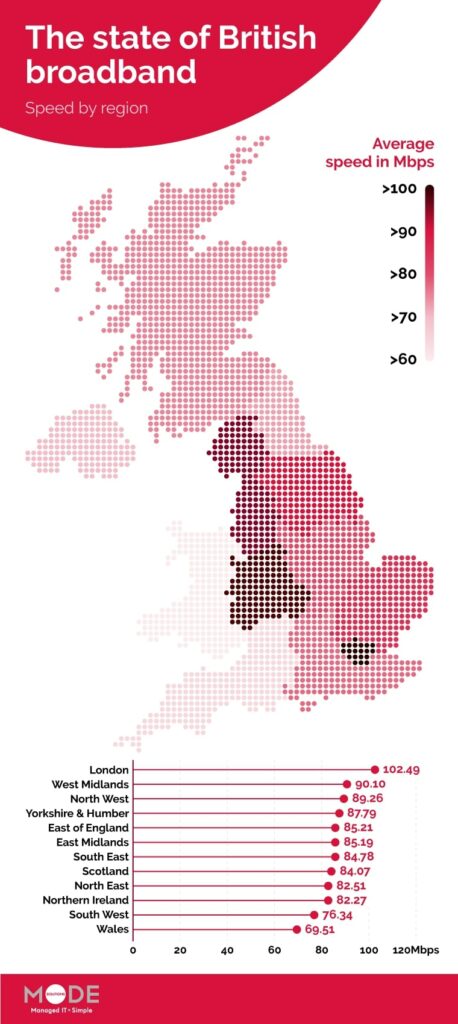
The picture that emerges from our data analysis is of the highest speeds being clustered around the South of England, with average connection speed dropping the further away you get from London. Average connection speeds in Wales are particularly poor, with the Southwest of England not far behind.
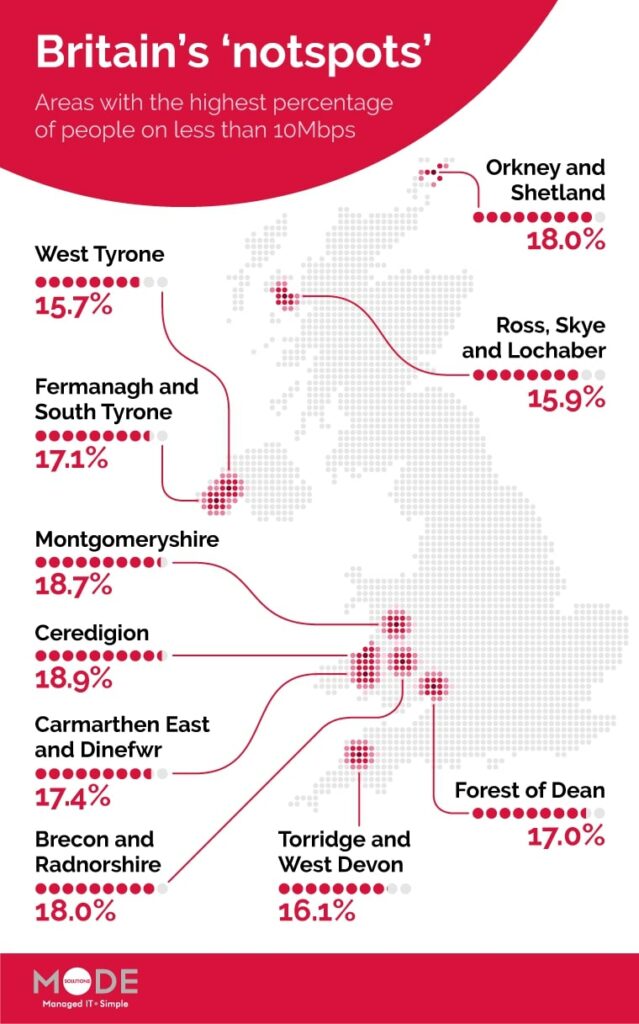
When we look at the location of Britain’s so-called ‘notspots’ – that is, places where usable broadband is hardest to access – we can see that they tend to be in places where the average speed is lower. This is true of the top three: Ceredigion and Montgomeryshire in Wales, and Orkney and Shetland in northern Scotland. Driving this are the various financial, logistical and ecological complexities of developing broadband infrastructure in hard-to-reach spots within these areas.
Will government action save the day?
In March 2021, the UK Government announced its £5bn ‘Project Gigabit’, commiting to deliver next-generation broadband to more than a million hard-to-reach homes. Cambridgeshire, Cornwall, Cumbria, Dorset, Durham, Essex, Northumberland, South Tyneside and Tees Valley are tabled as the first areas to benefit, with 510,000 homes in these locations set to receive speeds of 1000 Mbps – or one Gigabit. Work started in these locations in the first half of 2022. Norfolk, Shropshire, Suffolk, Worcestershire, Hampshire and the Isle of Wight are next in line to benefit.
However, the government has stated that Project Gigabit won’t cover the whole of the UK, with certain remote locations not considered a viable choice for new internet infrastructure. The solution could lie in “new wireless equipment, low orbit satellites or high-altitude platforms to beam faster connections to far-flung homes and businesses” – but this is not within the scope of the scheme. There is also potential for 5G to pick up the slack – although this is a way off. Leading provider EE recently announced that whilst their network covers over half of the UK, it won’t be until 2028 that the entirety of the UK has 5G access.
If you live in a remote location, these words will not offer much hope. And given how difficult it is for individuals and businesses to move from one part of the country to another, disparities in broadband access are becoming a cause of inequality and inefficiency that is hard to ignore. For the digital transformation of the UK to go from dream to reality, this pressing issue must be addressed.
About Espria
In a world permanently altered by COVID-19, Espria provides the crucial hybrid and remote working solutions that enable workforces to collaborate effectively and securely.
Our aim is to make things simple. Simple to understand, simple to manage – a business operation that’s seamless and hassle free. We focus on delivering outstanding services that are also future-proofed. With the right tools, your teams can operate at maximum efficiency whether they’re in the office or working from home.
Additionally, our recent acquisition of IT managed services provider eacs has extended Espria’s geographical reach, helping us provide our full suite of integrated solutions to businesses across the nation. We don’t think location should be an impediment to having top-notch IT systems.
To learn more about Espria or get a quote, contact us today.
Subsribe for updates and our latest research
You may be interested in

From AI Experimentation to Real Business Outcomes: Our Takeaways from Microsoft Frontier Tour London
This week, Pete Graham, Microsoft Business Manager at Espria, attended Microsoft Frontier Tour London alongside members of the wider Espria team to hear directly from Microsoft leaders, partners and customers about the future of artificial intelligence. Having attended Microsoft’s AI Tour last year, Pete was interested to see how the conversation had evolved over the past 12 months. What became clear throughout the day was that the discussion around AI has matured significantly. A year ago, many organisations were still asking what AI could do. Today, the focus is increasingly on how to adopt it…
Critical PHP vulnerabilities: do you know who owns the fix?
When websites and applications sit with different teams and suppliers, the first challenge is knowing who needs to act. Critical vulnerabilities have been disclosed affecting PHP, a technology widely used across websites, web applications and other software products. The technical advice is clear: identify affected systems and apply the available updates. But for many organisations, the first challenge is understanding where PHP is being used, who manages those systems and who is responsible for taking action. To help you identify potential exposure, we have created a PHP Security Checker to determine whether your systems have…
Beyond the Filing Cabinet: What Document Management Actually Saves You
Document Management for Small Offices with DocuWare For many small offices, document management still means a filing cabinet, a shared drive with inconsistent folder names, and a lot of time spent searching for the one contract or invoice somebody needs right now. DocuWare replaces that with a structured, searchable system that sits behind your everyday paperwork. What does DocuWare mean in practice? Giving Office Managers time back For an Office Manager who is often the person holding the whole administrative process together, this is time back. Fewer interruptions to find a document for a colleague,…

Copilot vs. Claude
Why Microsoft 365 Copilot fits every day work A plain-English guide for people trying AI at work: what Copilot does, how it differs from a separate assistant such as Claude and where to start. The short answer Claude is a separate AI workspace. Copilot sits inside the Microsoft apps many teams already use and can work with the emails, files and meetings each person is allowed to access. A separate assistant helps when: Copilot helps when: – You need help creating or developing content from scratch. – The task is focused research, reasoning or code….
Microsoft is changing Copilot billing. Here’s how to stay in control of AI costs
From 1 December 2026, new Microsoft 365 Copilot Business purchases through CSP will come with usage-based billing already configured. At first glance, that might sound like another variable cost for IT and finance teams to manage. But it also gives businesses a practical way to access the next generation of Copilot experiences while retaining control over who can use them, how much they can spend and where that money goes. This matters because Copilot is changing. New experiences such as Copilot Cowork are designed to carry out larger, multi-step pieces of work. That creates more…

Phishing just got personal
AI-powered phishing attacks are becoming harder to detect, with increasingly sophisticated emails bypassing traditional security controls. As a result, organisations are placing greater focus on Human Risk Management, recognising employee behaviour as a measurable cybersecurity risk. SecureLearn, powered by KnowBe4 and fully managed by Espria, helps businesses reduce human risk through continuous security awareness training, phishing simulations, targeted coaching, and board-ready reporting that demonstrates improvement over time.