
From AI Experimentation to Real Business Outcomes: Our Takeaways from Microsoft Frontier Tour London
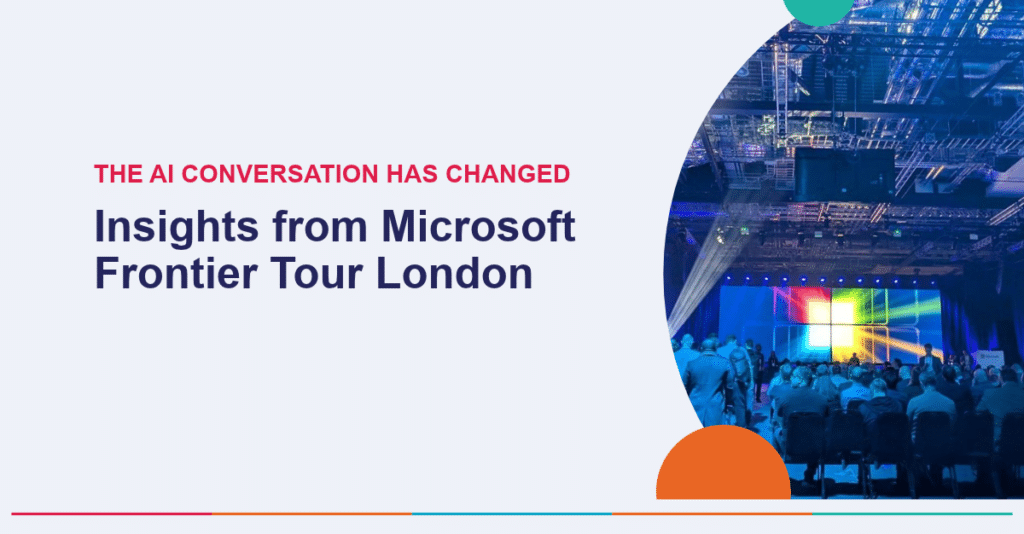
This week, Pete Graham, Microsoft Business Manager at Espria, attended Microsoft Frontier Tour London alongside members of the wider Espria team to hear directly from Microsoft leaders, partners and customers about the future of artificial intelligence.
Having attended Microsoft’s AI Tour last year, Pete was interested to see how the conversation had evolved over the past 12 months.
What became clear throughout the day was that the discussion around AI has matured significantly.
A year ago, many organisations were still asking what AI could do. Today, the focus is increasingly on how to adopt it securely, govern it effectively and turn it into measurable business outcomes. The technology continues to evolve at pace, but the real challenge now is helping organisations use it in ways that create genuine value.
The technology has matured. So has the conversation.
Reflecting on the event, Pete noted that while many of the themes felt familiar, the focus has shifted considerably.
“There was definitely a bit of déjà vu arriving at the Microsoft Frontier Tour. Having attended the AI Tour last year, I was interested to see just how much had changed, and how much had stayed the same.”
Where previous discussions often centred on generative AI and productivity gains, this year’s event focused on something broader: how AI becomes embedded across organisations, helping connect people, data, applications and decision-making.
Microsoft’s vision is moving beyond AI as a personal assistant. The emphasis is increasingly on agents, automation, application development and AI-powered systems that can support or perform tasks across business processes.
Being AI-first is no longer simply about adding AI to existing solutions.
Instead, organisations are beginning to think differently about how technology, data and business processes work together, with AI serving as a foundational capability rather than an additional feature.
From Copilot to Agents: The Next Phase of AI
One of the standout themes from the day was the move towards intelligent agents capable of supporting increasingly complex tasks and workflows.
For many organisations, this represents the next stage of AI adoption.
The discussion is no longer limited to helping users write documents, summarise meetings or generate content. Businesses are beginning to explore how AI can support decision-making, automate repetitive processes, connect disconnected systems and unlock greater value from their existing data.
That’s exciting, but it also raises important questions.
If AI systems are capable of taking action on behalf of users, how do organisations ensure those actions remain secure, controlled and auditable?
Those questions appeared repeatedly throughout the event and are likely to shape the next phase of AI adoption.
Security and Governance Are Becoming Fundamental
One of the strongest themes emerging from the event was the growing overlap between AI and cybersecurity.
As organisations introduce AI assistants and agents into their environments, identity, access control, governance and observability become increasingly important. Businesses need to understand not only what their AI tools can do, but also what they have access to, how they operate and how they are monitored.
As Pete observed:
“The AI opportunity and the cybersecurity opportunity are rapidly becoming the same conversation. As organisations give AI access to more information and more processes, governance becomes just as important as capability.”
For organisations considering their next steps with AI, this is likely to become one of the defining challenges of the coming years.
Success will require more than deploying new tools. It will require the right governance, security controls, policies and visibility to ensure those tools are being used safely and effectively.
The Biggest Challenge Isn’t Technology. It’s Adoption.
Perhaps the most important takeaway from the event wasn’t about technology at all.
Throughout the day, there was a recurring theme around skills, confidence and adoption. While AI capabilities continue to advance, not every organisation is progressing at the same pace when it comes to helping people understand and use them effectively.
The tools are increasingly available. The challenge is ensuring employees know how to apply them in ways that create meaningful outcomes.
For many organisations, that means moving beyond licences and deployments towards broader adoption programmes that include training, governance, use-case discovery and ongoing optimisation.
Pete summed it up neatly:
“Most organisations don’t have a technology problem. They have an adoption problem. The tools are becoming increasingly powerful, but people still need support, training and clear use cases if they’re going to unlock the value.”
In many ways, AI adoption now resembles previous waves of digital transformation.
The organisations that achieve the greatest success are unlikely to be those with access to the most technology. They will be those that give their people the skills, confidence and support needed to use it effectively.
Where Are the Mid-Market Success Stories?
The event featured a number of impressive customer examples, including global organisations using AI, analytics and automation at scale.
While these stories demonstrate what’s possible, they can sometimes feel distant from the reality facing many mid-market organisations.
That was one of the most interesting observations from the day.
Microsoft has no shortage of examples showing how the world’s largest enterprises are embracing AI. However, many organisations want to see stories that feel closer to home. They want practical examples from businesses facing similar challenges, operating with similar resources and working towards similar goals.
Often, the most valuable AI success stories aren’t the most ambitious.
They’re the stories about saving time, improving customer service, streamlining reporting, reducing manual effort or helping employees work more effectively.
What Microsoft Frontier Tour London Means for Organisations Today
If there was one message that came through consistently at Microsoft Frontier Tour London, it was that AI adoption is no longer about experimentation. It’s about execution.
The technology is advancing rapidly. New capabilities will continue to emerge. But the organisations that see the greatest value will be those that focus on three things:
- Identifying meaningful business outcomes
- Putting the right security and governance foundations in place
- Helping their people adopt AI with confidence
Reflecting on the day, Pete believes the market is entering a new phase of AI adoption.
“Last year, the conversation was largely about what AI could do. This year, the conversation was much more focused on how organisations actually make it work in practice. That’s a positive shift, because business outcomes should always be the goal.”
For Espria, that’s where the real opportunity lies.
Not simply helping organisations gain access to AI, but helping them understand where it can deliver value, how it can be introduced safely and how success can be measured over time.
Because ultimately, AI isn’t the outcome.
Better decisions, more productive teams, improved customer experiences and more efficient ways of working are the outcomes that matter.
Ready to move beyond AI experimentation?
Whether you’re exploring Copilot, building an AI strategy or looking to improve adoption across your organisation, our specialists can help you identify practical use cases, establish the right governance foundations and create measurable business outcomes.
Talk to an AI Specialist
You may be interested in
What Happens to Your Printer Cartridges After You Use Them?
Is Your Printer Recycling Actually Making a Difference? Most businesses know they should recycle their printer consumables. Fewer know what actually happens to a cartridge once it leaves the office, or whether their current supplier is doing anything meaningful with it at all. A smarter approach to printer consumables Under a properly managed print service, consumables are handled with a clear process rather than left to chance: One less thing for Office Managers to manage For an Office Manager, this also removes a recurring low-value task: nobody needs to track toner stock levels, notice a…
Taking Control of Print Costs Without Micromanaging Staff
The Hidden Cost of Office Printing Print costs have a habit of creeping up quietly: a few extra colour pages here, an unnecessary duplicate print there, a job sent to the wrong printer and reprinted. On their own, none of these feel significant. Across a whole office, over a year, they add up to a real and often invisible cost. See where your print spend is going PaperCut gives an Office Manager visibility and control over this without needing to police individual print jobs. In practice, this looks like: Reduce waste without restricting staff The…
Five Printer Security Risks Most Small Offices Never Think About
5 Print Security Risks Hiding in Your Office Following on from our earlier piece on printers as network endpoints, it is worth being specific about what actually goes wrong. These are the five risks we see most often when we assess a print fleet for the first time. The five print security risks to look out for 1. Default or shared admin passwords. Many devices are still running the password they arrived with, often known publicly for that model. 2. Unsecured print queues. Documents sitting in a print queue, or printed and left uncollected in…
Critical PHP vulnerabilities: do you know who owns the fix?
When websites and applications sit with different teams and suppliers, the first challenge is knowing who needs to act. Critical vulnerabilities have been disclosed affecting PHP, a technology widely used across websites, web applications and other software products. The technical advice is clear: identify affected systems and apply the available updates. But for many organisations, the first challenge is understanding where PHP is being used, who manages those systems and who is responsible for taking action. To help you identify potential exposure, we have created a PHP Security Checker to determine whether your systems have…
Beyond the Filing Cabinet: What Document Management Actually Saves You
Document Management for Small Offices with DocuWare For many small offices, document management still means a filing cabinet, a shared drive with inconsistent folder names, and a lot of time spent searching for the one contract or invoice somebody needs right now. DocuWare replaces that with a structured, searchable system that sits behind your everyday paperwork. What does DocuWare mean in practice? Giving Office Managers time back For an Office Manager who is often the person holding the whole administrative process together, this is time back. Fewer interruptions to find a document for a colleague,…
Copilot vs. Claude
Why Microsoft 365 Copilot fits every day work A plain-English guide for people trying AI at work: what Copilot does, how it differs from a separate assistant such as Claude and where to start. The short answer Claude is a separate AI workspace. Copilot sits inside the Microsoft apps many teams already use and can work with the emails, files and meetings each person is allowed to access. A separate assistant helps when: Copilot helps when: – You need help creating or developing content from scratch. – The task is focused research, reasoning or code….